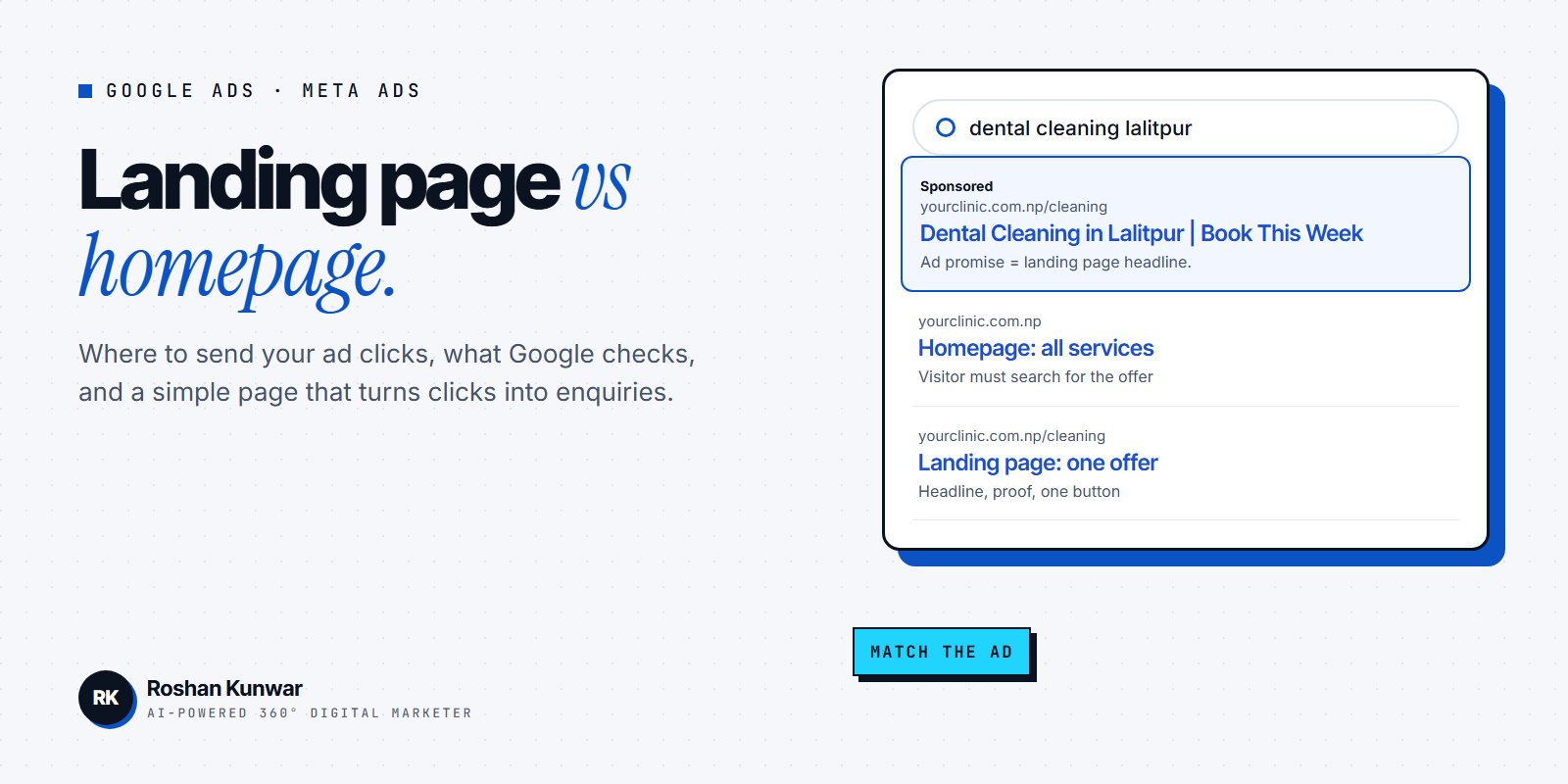
One of the most common ad mistakes I see in Nepal is this: a business writes a specific ad, for example "Dental cleaning in Lalitpur, book this week", and then sends every click to the homepage. The visitor lands on a page about the whole clinic, a slider, an about-us section and ten services. They do not see the offer they clicked, so they leave.
Searches like "landing page vs homepage" and "landing page meaning" show many people are not sure what the difference is. This guide explains it simply, shows when each one makes sense, and gives a checklist for building a landing page that works with Google Ads and Meta Ads.
Landing page vs homepage: the difference
| Homepage | Landing page | |
|---|---|---|
| Purpose | Introduce the whole business | Get one specific action |
| Audience | Anyone: new visitors, returning customers, job seekers | People who clicked a specific ad or link |
| Content | All services, about, news, contact | One offer, its benefits, proof and next step |
| Navigation | Full menu with many links | Few or no extra links |
| Call to action | Several | One main action |
| Best traffic source | Brand searches, direct visits, SEO | Paid ads, email campaigns, specific promotions |
Both are useful. The question is which page should receive the traffic from a particular ad.
What Google says about landing pages
Google Ads uses Quality Score as a diagnostic tool. Google's Quality Score help page says it is based on three components: expected clickthrough rate, ad relevance and landing page experience, which is how relevant and useful your landing page is to people who click your ad.
Google's ads and landing page optimisation guide gives clear advice:
- Choose a landing page that closely matches your ad and keywords.
- The landing page should mirror the call to action in your ad. If the ad says "sign up for a free tour", the page should show a sign-up form prominently.
- Make the page mobile-friendly, quick and easy to contact you from.
- Make the desired action quick and easy, avoid clutter and pop-ups, and put important information near the top.
- Provide useful, original information about what you are advertising, such as real customer reviews.
The same logic applies to Meta Ads. Someone who clicks an Instagram ad for a specific course batch wants to see that batch, the date, the fee if you show it, and how to join.
When the homepage is fine
You do not always need a separate landing page. The homepage can work when:
- The ad is about your brand, for example someone searches your business name.
- You sell one main product or service, and the homepage already focuses on it with a clear button.
- The goal is awareness, not a direct action, and you mainly want people to learn who you are.
In most other cases, a dedicated page will convert better because the visitor does not have to search for the offer.
When you need a landing page
| Situation | Better destination |
|---|---|
| Ad for one specific service, such as "AC repair in Kathmandu" | A page only about that service |
| Ad for a course batch or event | A page for that batch with date, details and registration form |
| Ad for a festival offer | An offer page with the deadline and products |
| Ad for a free consultation or quote | A page with a short form and what happens next |
| Ad for one product | The product page, not the shop's homepage |
If you run Google Ads for several services, create one page per service and send each ad group to its matching page. My Google Ads campaign types guide shows how campaigns and ad groups fit together.
What a good landing page includes
Use this checklist for any ad landing page:
- A headline that repeats the ad's promise. If the ad says "Website for your business in 15 days", the headline should say the same thing.
- One short paragraph explaining who it is for and what they get.
- Key details people need to decide: location, dates, what is included, delivery area, and price or "price on request".
- Proof: real reviews, photos of real work, client logos or project results. Only use results you can show.
- One main call to action: a form, a call button, or a WhatsApp or Messenger button. Keep forms short; name, phone and one question is often enough.
- Fast loading on mobile. Most visitors in Nepal will come from phones, often on mobile data. Compress images and avoid heavy sliders.
- Tracking. Add Google Ads conversion tracking and the Meta Pixel so you know which ads bring enquiries. See my Meta Pixel setup guide.
- Few distractions. Remove or reduce the main menu, and avoid pop-ups that cover the offer.
A simple landing page structure
| Section | Content |
|---|---|
| Top | Headline matching the ad, one line of support text, main button |
| Benefits | 3 to 5 short points about what the customer gets |
| Details | What is included, location or delivery, timing, price or how pricing works |
| Proof | Reviews, photos, project examples |
| FAQ | 3 to 5 common questions people ask in messages |
| Bottom | The same main button or form again |
You can build this on your existing website as a new page, without a separate tool. If your website makes it hard to add pages, that is a sign it needs work; my web development service builds pages that are easy to add and change.
How to test your landing page
- Click your own ad path on a phone. Does the page load quickly and show the offer immediately?
- Ask someone outside the business what the page offers and what to do next. If they cannot answer within a few seconds, simplify.
- Use Google's testing tools. Google Ads Help links to tools for testing landing page speed on mobile.
- Compare results. After two to four weeks, compare cost per enquiry for ads sent to the homepage and ads sent to the landing page.
FAQ
Is a landing page the same as a website?
No. A landing page is usually one page inside your website, built for a single offer or campaign. Your website includes the homepage, service pages, blog and contact page.
Can I use my homepage for Google Ads?
Yes, for brand searches or if your business has one main service. For specific services or offers, a matching landing page usually gives a better experience and supports a better Quality Score.
Does a landing page help SEO?
A landing page built only for ads often has little content and may not rank. A detailed service page can do both jobs: rank in Google and receive ad traffic. My SEO services cover how to plan those pages.
How many landing pages do I need?
Start with one for each main service or offer you advertise. You do not need a new page for every ad, only for every distinct promise.