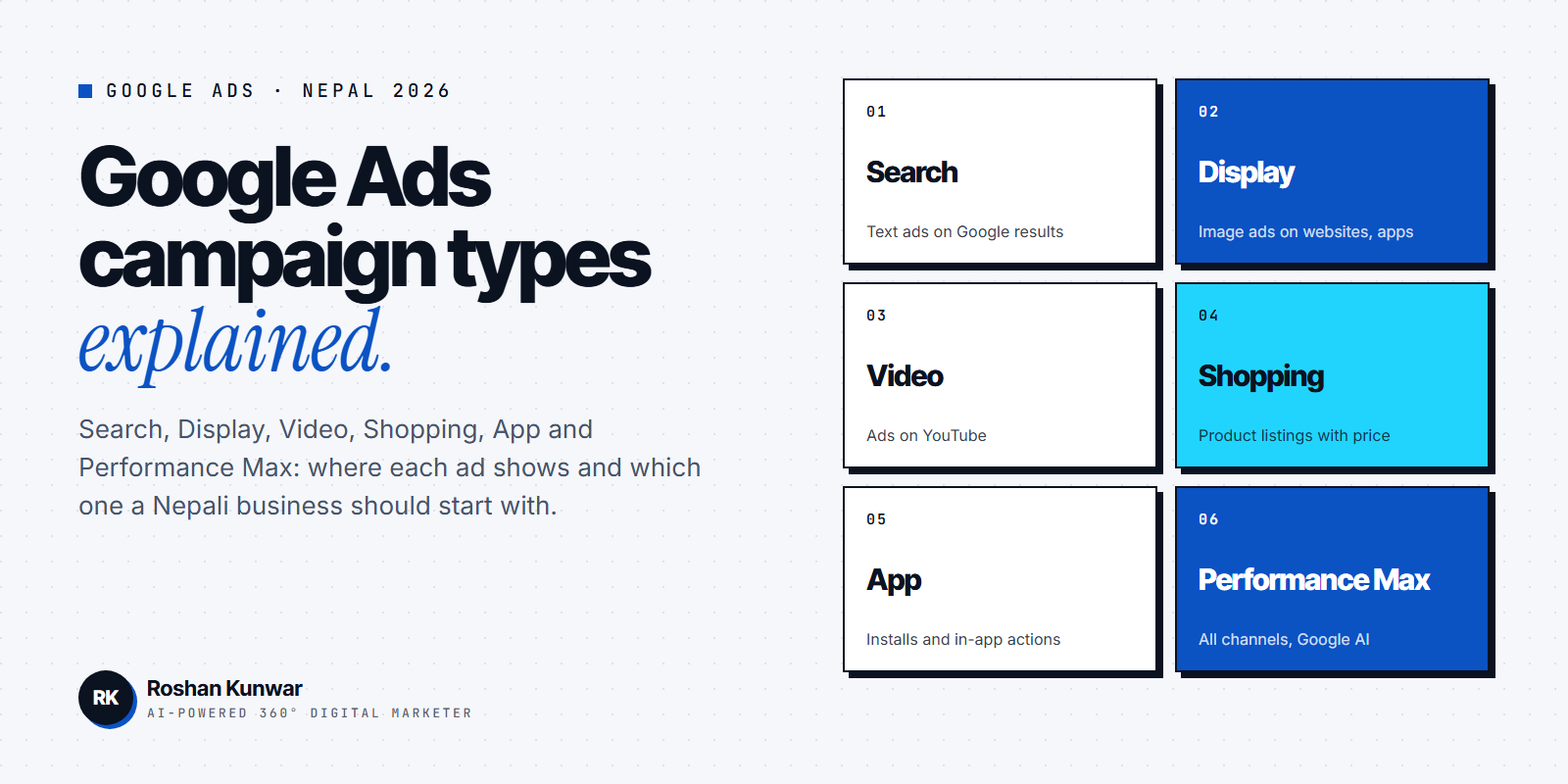
When you create your first campaign, Google Ads asks you to choose a campaign type. The names sound similar, and the wrong choice is the most common reason a Nepali business spends its first budget without a single enquiry. This guide explains every main campaign type in plain words, what it needs from you, and which one fits which kind of business in Nepal.
Everything below about how each campaign works comes from Google's help page Choose the right campaign type, checked on 11 November 2026. The Nepal advice is from my own work running ads for local clients.
Why the campaign type matters
A campaign type decides three things at once: where your ad appears, what format it uses (text, image, video or product listing) and how much Google automates. The campaign type should match where your customer is. A person typing "water purifier price in Nepal" into Google is best reached with a Search ad. A person watching YouTube in the evening is reached with a Video ad.
The main Google Ads campaign types
| Campaign type | Where the ad shows | Ad format | Best for |
|---|---|---|---|
| Search | Google search results | Text ads with keywords | Sales, leads and website traffic from people actively searching |
| Display | Websites, apps and Google-owned sites such as YouTube | Image ads | Reach, staying top of mind, following up with past visitors |
| Video | YouTube and other sites | Video ads | Brand awareness, views and conversions |
| Shopping | Search results and the Shopping tab | Product listings with image and price | Retailers with an online product catalogue |
| App | Search, Play, YouTube, Discover and millions of sites and apps | Automated app ads | App installs, in-app actions and pre-registration |
| Performance Max | All Google channels from one campaign | Your assets combined by Google AI | Conversion goals such as sales, leads or store visits |
Google's menu also lists Smart campaigns, Demand Gen campaigns, Hotel campaigns and Call campaigns, but the six above are the ones a small business in Nepal will actually choose between.
Search campaigns: text ads on Google results
Search campaigns are text ads that appear when someone searches on Google for the products and services you offer. Google describes them as great for driving sales, leads or traffic because the people who see them are actively searching.
What you need: written text ads and a list of keywords. Google notes that you can skip special files or assets, which makes this the fastest type to set up.
In Nepal, this is the campaign I recommend first for service businesses such as clinics, consultancies, repair services, institutes and agencies, and for any shop that sells something people search for by name. If you are new, my Google Ads for beginners guide walks through the first Search campaign step by step.
Display campaigns: image ads on websites
Display campaigns show visually engaging ads while people browse websites, apps and Google-owned properties such as YouTube. Google positions them as a way to expand your reach and stay top of mind beyond Google Search.
Display also supports your data segments, which means you can show ads to people who already visited your website or used your app. Google's tip is practical: prepare square and landscape versions of your image in the right dimensions and file size.
In Nepal, Display works best as a follow-up campaign after you have website visitors to re-engage. Expect lower click rates than Search, because people are not looking for you at that moment.
Video campaigns: ads on YouTube
Video campaigns show video ads on YouTube and other websites. Google lists several Video campaign types, including Drive conversions (action-focused video ads), Video reach campaigns (the most reach for your budget using bumper, skippable or non-skippable formats), Get views (skippable in-stream or in-feed ads) and Ad sequence (a series of videos that tell a story).
One requirement to plan for: Google says you first need to create your video ad and upload it to YouTube. If you do not have a video yet, an AI video ad is a fast way to produce one for a product, course or offer.
Shopping campaigns: product listings
Shopping campaigns are product listings with an image and price that appear on search results and the Google Shopping tab. Google says they are ideal if you are a retailer selling a product inventory, and that store owners can also use local inventory ads for products available in a physical shop.
The requirement is a Google Merchant Center account with your product inventory uploaded. Before you plan a Shopping campaign for a Nepali store, confirm in Merchant Center that your country and currency are supported for the features you need, because availability differs by country and changes over time.
App campaigns: promote an app
App campaigns help you find new app users and increase sales inside the app. Google says this type uses information from your app to automatically optimise ads across Search, Play, YouTube, Discover and over 3 million sites and apps. Eligible accounts see three subtypes: App installs, App engagement and App pre-registration.
For Nepali fintech, delivery, education and ride apps, this is the campaign type to use rather than a Search campaign.
Performance Max: all channels in one campaign
Performance Max is a goal-based campaign type that gives you access to all Google Ads inventory from a single campaign. Google says it optimises your budget and bids across channels in real time using Smart Bidding, and that you steer results by providing high-quality creative assets and sharing which audiences are most likely to convert.
Two details from Google's guide matter in practice:
- Performance Max appears as a choice when your objective is Sales, Leads, or Local store visits and promotions.
- If you want a different campaign type and Performance Max is the only option showing, choose "Create a campaign without a goal's guidance" to see all campaign types.
My advice for Nepal: Performance Max needs conversion tracking and a decent volume of conversions to learn from. A new account with no tracking and a small budget usually gets better, more understandable results from a Search campaign first. Move to Performance Max once your website tracks enquiries or orders properly.
How to choose: a simple decision table
| Your situation | Start with |
|---|---|
| People search for your service or product by name | Search |
| You sell many products online and have a Merchant Center account | Shopping, or Performance Max with a Merchant Center feed |
| You have a good video and want awareness | Video |
| You want to bring back past website visitors | Display with your data segments |
| You have an app | App |
| You have conversion tracking, enough data and want Google to spread budget across channels | Performance Max |
If you are comparing Google with Meta for the same budget, read Google Ads vs Facebook Ads in Nepal. For what a Search campaign costs locally, see Google Ads cost in Nepal.
Practical steps before you create any campaign
- Write down one goal in a sentence: "get phone calls for AC repair in Kathmandu" is a goal, "get more customers" is not.
- Set up conversion tracking for that goal, such as form submissions, calls or WhatsApp clicks. Without it, Performance Max and Smart Bidding have nothing to optimise.
- Prepare the assets the campaign type needs: keywords and text for Search, square and landscape images for Display, a YouTube upload for Video, a product feed for Shopping.
- Start with one campaign type and one clear budget. Add a second type only after the first one shows results you can measure.
FAQ
Which Google Ads campaign type is best for a small business in Nepal?
For most small businesses, a Search campaign. It reaches people who are actively searching, needs only text ads and keywords, and its results are easy to read. Add Display or Video later for reach.
Do I need a video to run on YouTube?
Yes. Google says you first need to create your video ad and upload it to YouTube before building a Video campaign.
Is Performance Max better than a Search campaign?
Not automatically. Performance Max works best when you have conversion tracking, good creative assets and enough conversion data for Google AI to learn from. A new account with a small budget usually learns more from a Search campaign first.