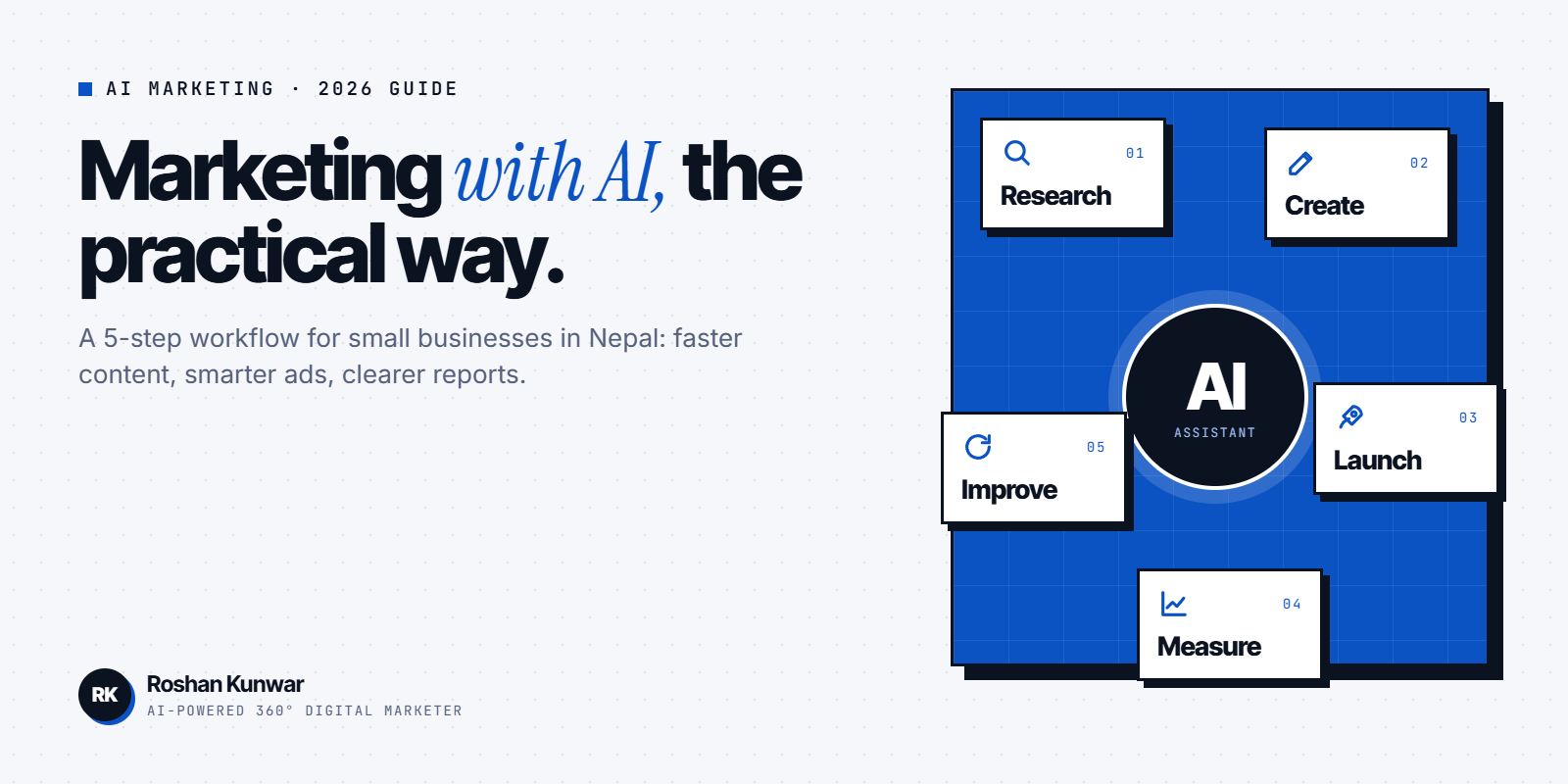
AI marketing is not about letting a tool run your brand. It is about doing the same marketing work — understanding customers, making content, running ads, reading results — in a fraction of the time, so you can do more of what actually grows sales.
I use AI every day for client work: planning campaigns, writing hooks, making product visuals and AI video ads, and reading ad reports. This guide is the workflow I actually use, written for small businesses, creators and marketers in Nepal.
What AI marketing actually means
AI marketing means using artificial intelligence tools inside your normal marketing process. In practice that means three kinds of help:
- Thinking help: customer research, competitor summaries, content ideas, campaign angles.
- Making help: first drafts of captions and scripts, design variations, product images, short AI video ads, translations between English and Nepali.
- Measuring help: turning ad and analytics numbers into plain-language insights and next steps.
What it does not mean: auto-posting AI content with no review, fake reviews, or replacing real customer conversations. Those shortcuts damage trust faster than they save time.
Why it matters in Nepal right now
Your customers are already online. According to DataReportal's Digital 2026 Nepal report, Nepal had 16.6 million internet users at the end of 2025 (56% of the population) and 14.8 million social media user identities. Meta's own ad tools reported a Facebook ad reach of about 14.8 million and a Messenger ad reach of about 11 million people in Nepal.
That is a big, competitive feed. Brands that post more often, test more ad ideas and reply faster win attention. AI is how a small team keeps up with that pace without a big budget.
The 5-step AI marketing workflow
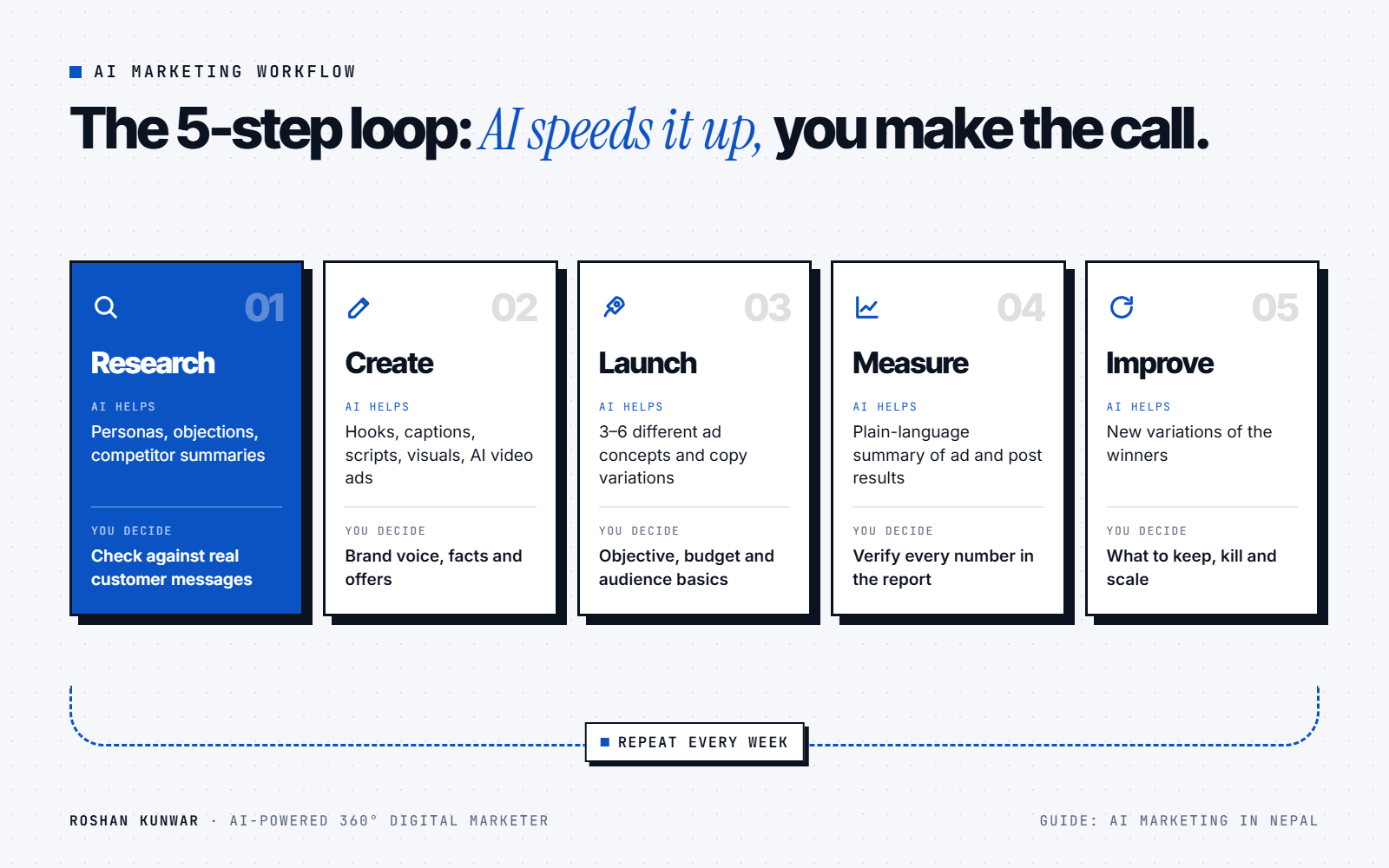
1. Research: understand the customer first
Give an AI assistant real inputs: your product, price, location, past customer questions from Messenger, and a few competitor pages. Ask it to group customers by need and list their top objections. You get a draft persona and objection list in minutes.
Then check it against reality. Read 20 real customer messages. AI is good at structure; your customers are the truth.
2. Create: drafts, variations and visuals
This is where AI saves the most time:
- Write 10 hook variations for one Reel idea, then pick the best 2–3.
- Turn one blog post into captions, a carousel outline and a 30-second script.
- Create product visuals and short AI video ads for testing different angles.
- Translate and adapt copy into natural Nepali or Romanized Nepali — and always have a native speaker read it.
3. Launch: test more ideas, not more money
On Meta ads, creative is now the main way the system finds your audience. Meta has said the focus has shifted from niche targeting to creative diversification. AI helps you produce genuinely different ad concepts — different hooks, formats and messages — so the algorithm has more to work with. I cover this in detail in my Meta ads guide for Nepal.
4. Measure: plain-language reports
Export your ad or Instagram results and ask AI to explain what changed, what is working and what to try next. It turns a spreadsheet into a short action list. Always double-check the numbers it quotes against the original report.
5. Improve: keep what works, kill what does not
Each week, keep the top performers, retire the weakest, and use AI to create new variations of the winners. This loop is what compounds results over months.
What AI should and should not do
| Task | Let AI help | Keep it human |
|---|---|---|
| Content ideas and hooks | Yes — generate many options | Choose what fits your brand |
| Captions and scripts | First drafts and variations | Final voice, facts, offers |
| Design and video | Variations, product shots, AI video ads | Brand consistency, final approval |
| Ads | Concepts, copy variations, report summaries | Budget, objective, offer, ethics |
| Customer replies | Suggested templates | Real conversations and complaints |
| Strategy | Brainstorm options | Positioning and priorities |
AI marketing tools I actually use
You do not need 20 subscriptions. A small stack covers most needs:
- An AI assistant (such as ChatGPT, Claude or Gemini) for research, writing and analysis.
- A design tool with AI features (such as Canva or Adobe Express) for fast, on-brand visuals.
- An AI image or video generator for product visuals and short ad concepts.
- Meta Ads Manager and Meta Business Suite for ads, scheduling and inbox.
- Google Search Console and Google Analytics to see what people search and what converts.
Tools change every few months. The workflow above stays the same.
Mistakes to avoid
- Publishing unedited AI text. It sounds generic and people notice. Edit for your voice and add real details.
- Letting AI invent facts. Prices, statistics and claims must come from you or a real source.
- Using AI faces or voices in a misleading way. If an ad uses an AI presenter, do not present it as a real customer testimonial.
- Skipping the measure step. Speed only helps if you learn from each campaign.
- Feeding private customer data into tools. Remove names and phone numbers before you paste anything.
A 7-day plan to start with AI marketing
- Day 1: Write down your product, price, top 3 customer types and top 5 questions customers ask.
- Day 2: Use AI to turn that into 3 content pillars and 20 post ideas.
- Day 3: Draft 5 captions and 3 Reel scripts; edit them into your voice.
- Day 4: Create visuals for the first week with an AI-assisted design tool.
- Day 5: Schedule posts and prepare 3 different ad concepts.
- Day 6: Launch a small test campaign with the 3 concepts.
- Day 7: Ask AI to summarise the first results, then plan next week.
FAQ
Is AI marketing expensive for a small business?
No. Most of the value comes from free or low-cost plans of an AI assistant and a design tool. The bigger cost is the time to learn a workflow — which this guide shortens.
Will AI content hurt my Google rankings?
Google rewards helpful, people-first content no matter how it is made. AI-assisted content that is edited, accurate and genuinely useful is fine. Thin, copy-paste AI pages are not. See my local SEO checklist for what actually moves rankings.
Can AI write in Nepali?
Yes, the major AI assistants can write Nepali and Romanized Nepali, but the tone can feel stiff. Use AI for the draft and let a native speaker polish it.
Should I hire an AI marketer or learn it myself?
Learn the basics yourself so you understand your marketing. When you want a full system — strategy, content, ads and reporting — that is where a 360° digital marketer saves you time.