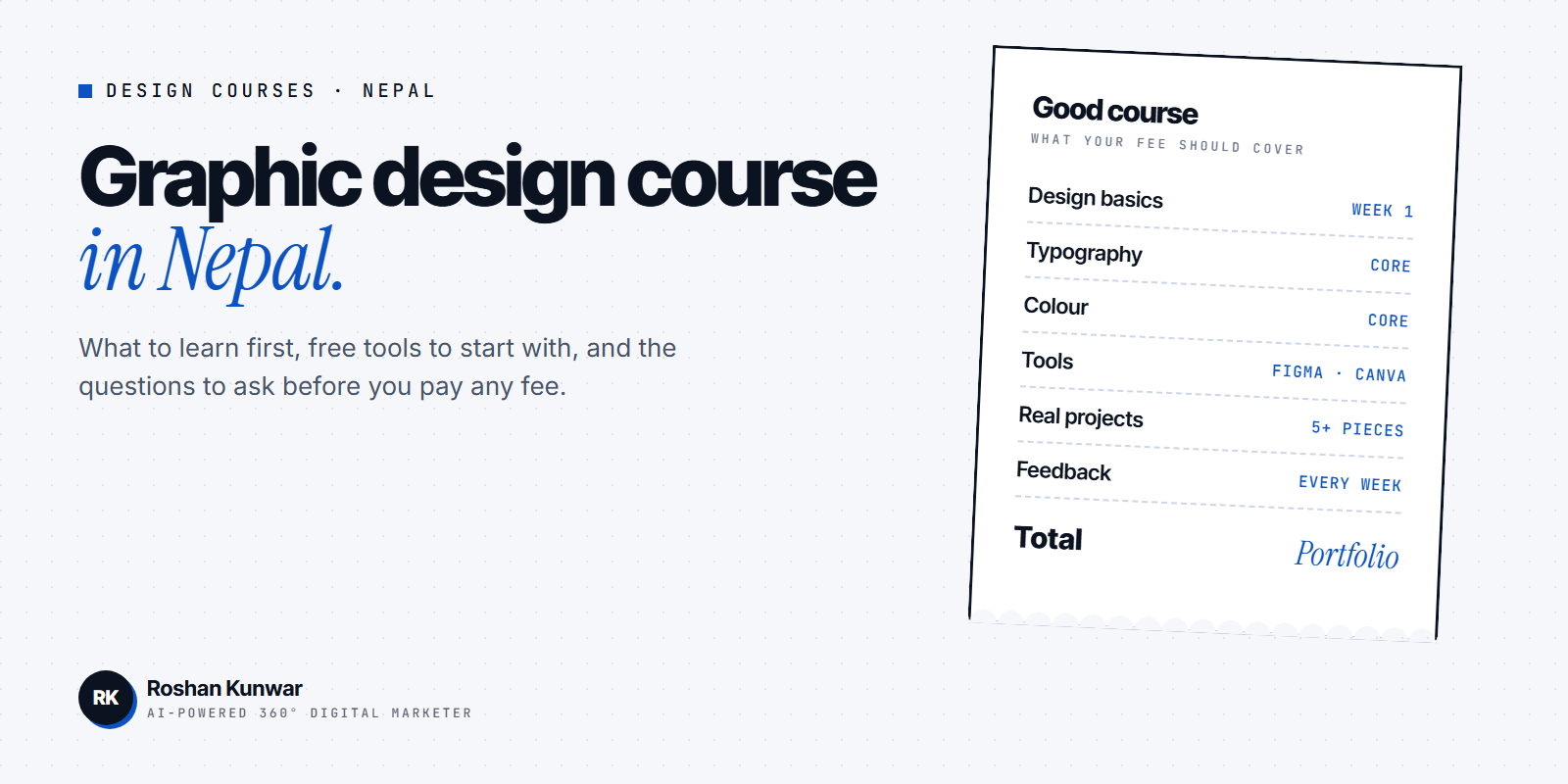
"Graphic design course in Nepal" is searched with "cost", "near me", "online" and "best". Before comparing fees, it helps to know what you should actually learn, in what order, and how to tell a useful course from one that only teaches buttons in software.
This guide is written for students, freelancers and business owners who want to design their own posts. I have not listed course fees, because they change often and vary by institute, city and duration. Check the current fee directly with each institute.
What you should learn, in order
Most beginners jump straight to software. The designers who get hired learn in this order:
| Stage | What to learn | Why it matters | Practice project |
|---|---|---|---|
| 1. Basics | Layout, alignment, spacing, hierarchy, contrast | Makes any design readable | Redesign a messy poster |
| 2. Typography | Choosing fonts, sizes, line spacing, pairing two fonts | Most designs are mostly text | Event poster with three text levels |
| 3. Colour | Colour palettes, contrast, brand colours | Builds recognition and readability | Three colour versions of one post |
| 4. Tools | Canva, Figma, Photoshop or Illustrator, or free alternatives | Lets you produce work fast | Recreate a post you admire |
| 5. Brand work | Logo, colour system, templates | What businesses pay for | Logo and Facebook cover for a local shop |
| 6. Real formats | Social posts, ads, brochures, packaging, print files | Where the jobs are | Brochure with a clear reading order |
A course that spends the first weeks only on software menus is skipping the part that makes your work look professional.
Free tools to start with before you pay
You can learn the basics and build a first portfolio with free tools, then decide whether paid software is worth it.
- Canva offers a Free plan alongside its paid Pro, Business and Enterprise plans, as shown on its pricing page. It is the fastest way to make social posts and simple flyers.
- Figma has a free Starter plan; its pricing page lists unlimited drafts, UI kits and templates on Starter. Figma is the standard for website and app design and works well for social media layouts too.
- GIMP is a free photo editing and image creation program, developed as free software under the GNU General Public License, according to the GIMP project.
Many agencies and print shops still ask for Adobe Photoshop and Illustrator skills, so a course that teaches them is useful if you want a job in an agency. If you mainly want to design for your own business or for social media clients, Canva and Figma are often enough to start.
What a good course should include
Use this list when you visit an institute or read an online course page:
- Design principles, not only software. Ask to see the syllabus for the first two weeks.
- Real projects you finish. Logo, social post series, brochure, a simple brand guide. You should leave with at least five finished portfolio pieces.
- Feedback on your work. Critique from the trainer, one to one or in class, is what improves you. Recorded videos alone rarely do.
- Current formats. Social media sizes, reels covers, ad creatives and print-ready files, not only posters.
- Portfolio and client basics. How to present work, price a project and talk to clients.
- Small class or real mentor time. Ask how many students each trainer handles.
Questions to ask before you pay
| Question | Good answer | Warning sign |
|---|---|---|
| Can I see work from past students? | Real portfolios, not only the trainer's work | Only certificates and photos of the classroom |
| How many projects will I finish? | A specific list | "Many projects" with no detail |
| Who gives feedback and how often? | Named trainer, regular critique | No feedback, only videos |
| Which software and which version? | Clear list, with reasons | Long list of every program |
| What happens after the course? | Portfolio review, internship or freelance guidance | "Guaranteed job" promises |
What real design projects look like
To see what "finished project" means, look at work that solves a business problem. In my UnlockSkill brand identity project, the brief was a logo that feels friendly to beginners, trustworthy enough to pay for a course, and clear on a small Facebook profile picture. The deliverables were a logo icon and wordmark, a colour palette, typography rules, a Facebook profile and cover, and a course post template.
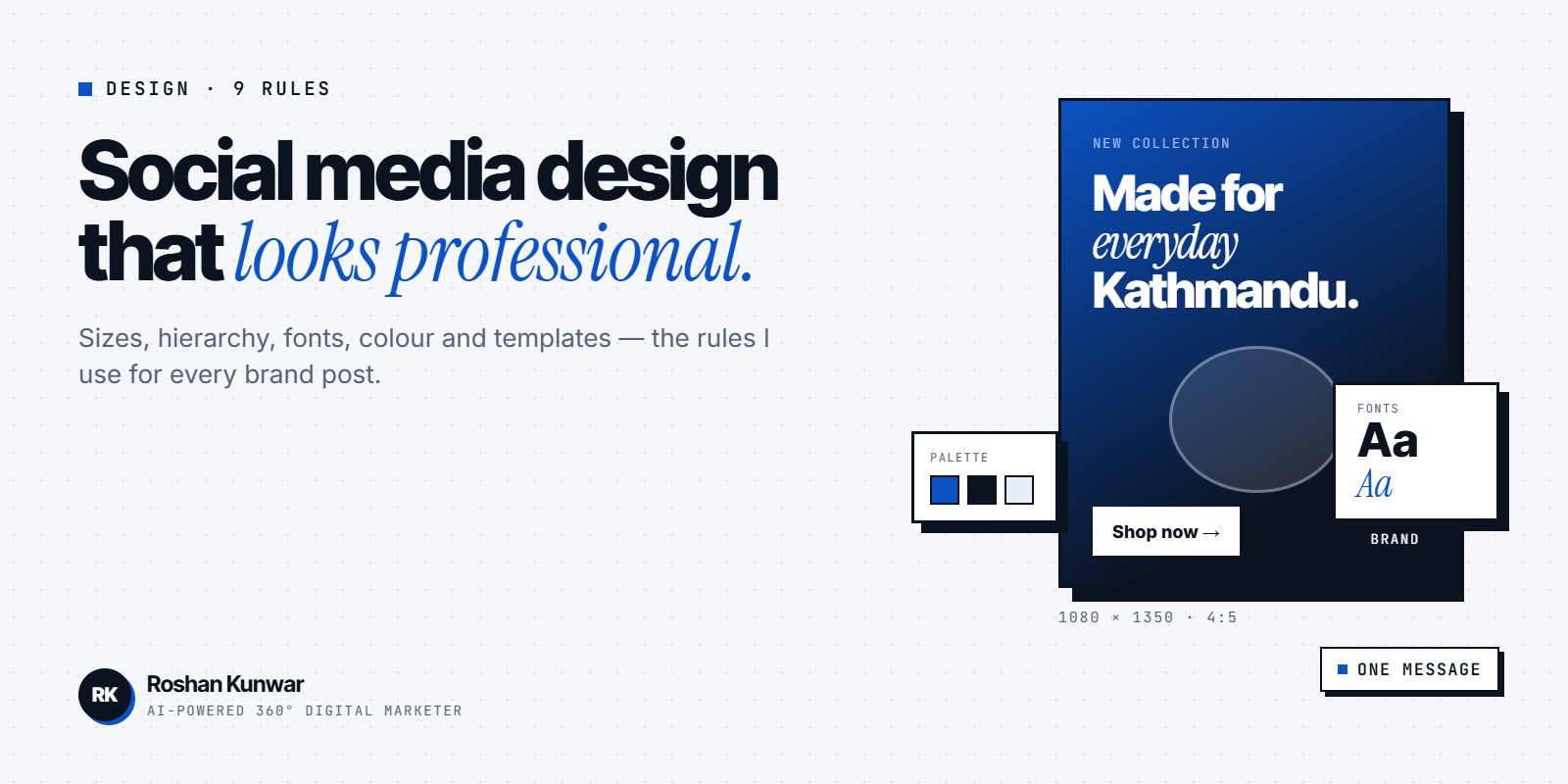
My product post concepts, such as the DualSense social post, use the 1080 × 1350 (4:5) social format with a three-level type system so the style can repeat across a series. A brochure project shows a different skill: a clear reading order across four panels. These are the kinds of pieces your portfolio should show after a course.
A 30-day self-study plan if you cannot join a course yet
- Week 1: Learn alignment, spacing and hierarchy. Redesign three posts from local businesses (for practice only, do not publish them as theirs).
- Week 2: Typography and colour. Make one poster in three font pairings and three colour palettes.
- Week 3: Tools. Recreate two designs you like in Figma or Canva, then make your own versions.
- Week 4: One brand project: logo, colour palette, Facebook cover and three social posts for an imaginary or real small shop.
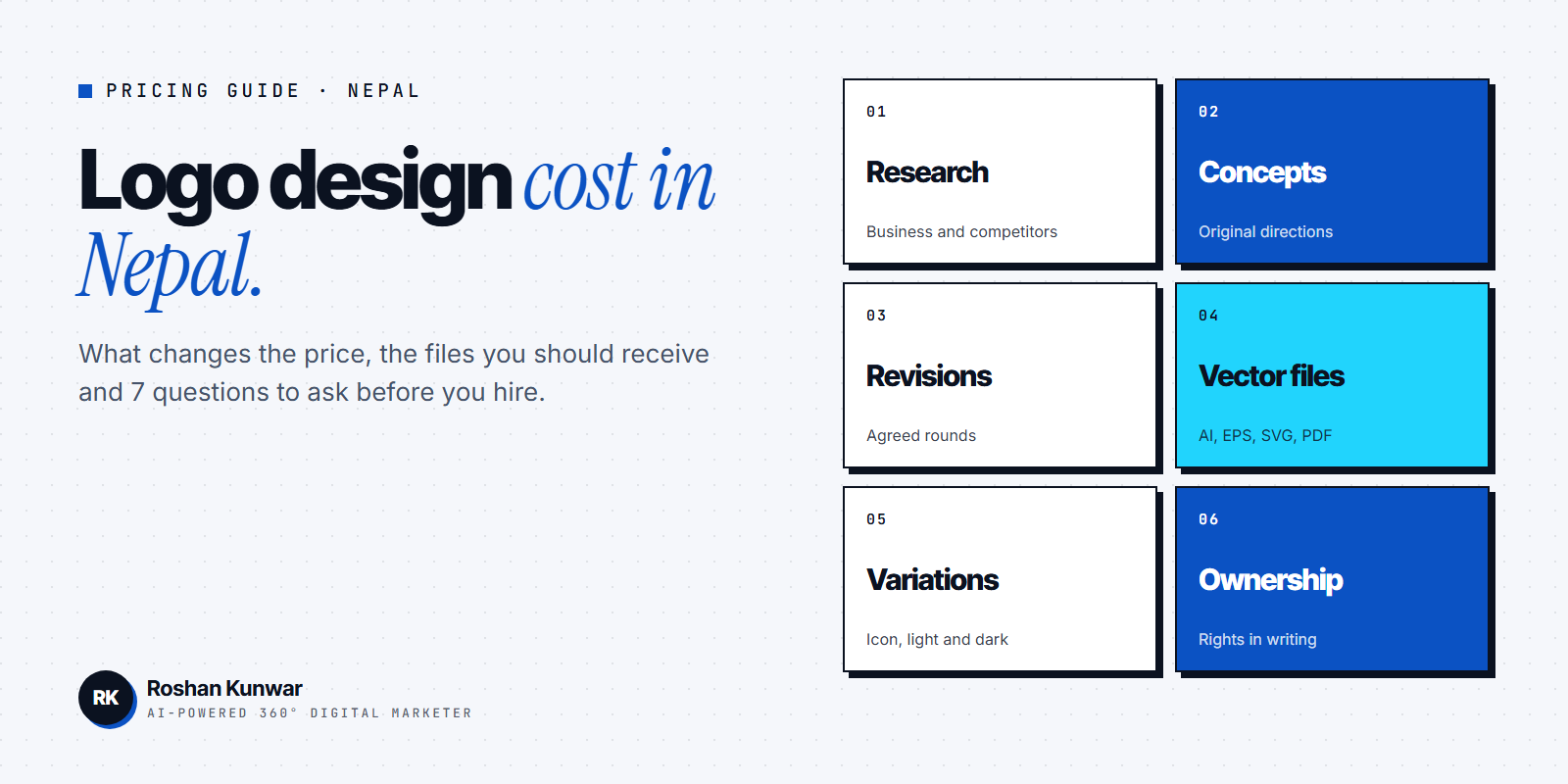
Then ask a working designer for honest feedback. If you want to sell design work, read freelancing in Nepal for students and logo design cost in Nepal to understand how clients think about price. For the rules that make social posts work, see social media design rules.
FAQ
Can I learn graphic design online in Nepal?
Yes. Online courses work if they include projects and feedback on your work. Free tools such as Canva's Free plan, Figma's Starter plan and GIMP let you practise without buying software first.
Which software should a beginner learn first?
Start with Canva or Figma to learn layout and typography quickly, then add Photoshop and Illustrator if you want agency or print work. The design basics matter more than the first tool you choose.
How long does it take to learn graphic design?
You can learn the basics in a few weeks of daily practice, but becoming job-ready takes months of real projects and feedback. A portfolio of five to ten strong pieces matters more than the length of the course.
Is a certificate needed to get design work?
Clients and agencies mainly look at your portfolio. A certificate can help with some employers, but real projects that solve business problems are what get you hired.