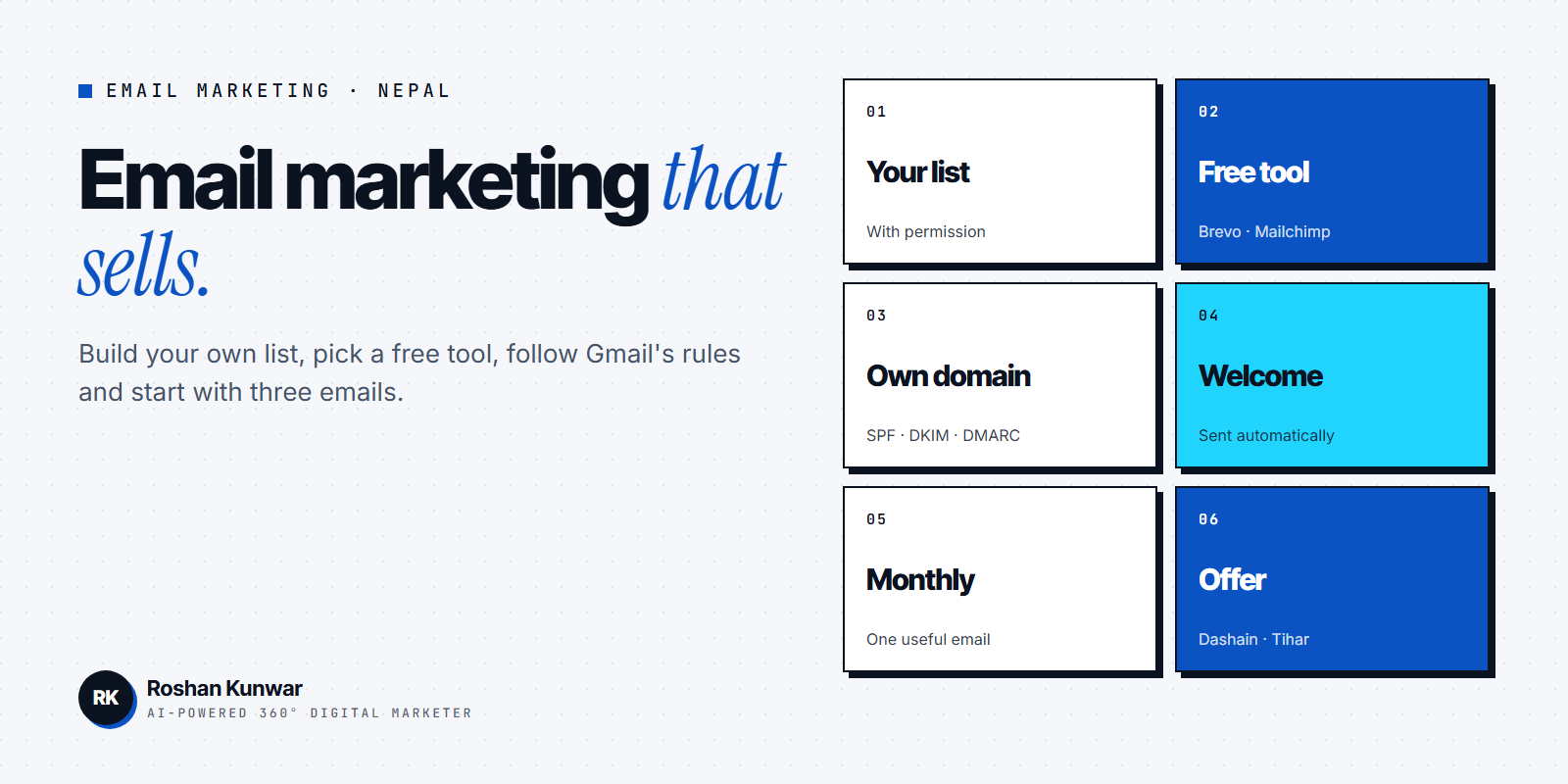
Most small businesses in Nepal put all their marketing effort into Facebook, Instagram and TikTok. Those platforms are important, but you do not own the audience there. If your page loses reach, or an account has a problem, your customer list is gone. An email list is different: it belongs to you, and you can reach people directly without paying for every view.
Searches like "email marketing Nepal" and "email marketing agency in Nepal" show that more business owners are asking whether email still works here. It does, for the right kind of business and when it is done with permission. This guide explains who should use it, how to start with free tools, and the rules you must follow so your emails reach the inbox.
Who email marketing works for in Nepal
Email is not equally useful for every business. It works best where customers buy more than once, or where the decision takes time.
| Business type | Good email use | Example |
|---|---|---|
| Training institute or course provider | New batch announcements, free class invites | "New Digital Marketing batch starts Sunday" |
| Online shop | New arrivals, restock alerts, festival offers | "Dashain collection is live" |
| Clinic, salon or gym | Appointment reminders, seasonal check-ups | "Time for your 6-month dental check-up" |
| Consultancy (education, visa, finance) | Deadlines, document checklists, updates | "Application deadline in 10 days" |
| B2B supplier or IT company | Product updates, case studies, quotes | "New price list for wholesale buyers" |
| Local restaurant or cafe | Weekly menu, events | Works, but WhatsApp or Instagram may be faster |
If your customers in Nepal mostly talk to you through Messenger or WhatsApp, keep those channels as your main sales tool and use email for longer content, receipts, reminders and offers. My WhatsApp Business guide covers that side.
Step 1: Build your list with permission
Your list is only valuable if people chose to join it. Good ways to collect emails in Nepal:
- Website form. A simple "Get offers and new arrivals by email" box on your home page and blog posts.
- Checkout and booking. Ask for email when someone orders, enrols or books, with a separate tick box for marketing emails.
- In-store or at events. A QR code that opens a short sign-up form.
- Free resource. A price list, checklist or short guide in exchange for an email address.
- Course and webinar registrations. People who register for a free class are often the best leads.
Do not buy or copy email lists. People who never asked for your emails will mark them as spam, and that damages delivery for every email you send afterwards.
Step 2: Choose a simple tool
You do not need an expensive system to start. Many email tools have free plans for small lists. Two examples, checked today on their official pricing pages:
| Tool | Free plan (as listed on the official page) | Good for |
|---|---|---|
| Brevo | Free plan; once the account is approved for sending, up to 300 emails per day | Small shops and institutes that also want SMS or WhatsApp later |
| Mailchimp | Basic Free plan for businesses with fewer than 500 contacts | Beginners who want ready templates |
Free plans have limits on features and branding, and pricing pages change, so check the current plan before you commit. Whatever tool you choose, connect it to an email address on your own domain, for example info@yourbusiness.com.np, not a free Gmail address. If you do not have a domain yet, read my .com.np domain registration guide.
Step 3: Follow the Gmail sender rules
Most of your subscribers in Nepal will use Gmail, so Google's rules decide whether your emails reach the inbox. Google's email sender guidelines apply to everyone who sends to Gmail accounts. In simple terms:
- All senders must set up SPF or DKIM email authentication for their sending domain, use a secure (TLS) connection, and keep the spam rate reported in Google Postmaster Tools below 0.3%.
- Senders of more than 5,000 messages per day to Gmail accounts must also set up SPF and DKIM, set up DMARC, and support one-click unsubscribe for marketing messages, with a clearly visible unsubscribe link in the email.
Most small businesses will not send 5,000 emails a day, but follow the stricter rules anyway: they are good practice and your email tool usually guides you through the DNS settings. If your website developer or host manages your DNS, ask them to add the SPF, DKIM and DMARC records your email tool gives you.
Step 4: Write three emails first
Do not try to send daily newsletters. Start with three emails that do real work:
- Welcome email. Sent automatically when someone joins. Say thank you, explain what they will receive and how often, and give one useful link, such as your best-selling products or a free guide.
- Monthly useful email. One tip, one short story or update, and one clear call to action. For a course institute: a learning tip plus the next batch date. For a shop: how to use or care for a product plus new arrivals.
- Offer email. Used for festivals (Dashain, Tihar, New Year) or launches. One offer, a clear deadline and one button.
Simple writing rules:
- Write a subject line that says what is inside, not clickbait.
- Use the language your customers use with you: English, Nepali or a natural mix.
- Keep one main button per email.
- Make it readable on a phone; most people will open it there.
- Add your business name, address or contact details and the unsubscribe link at the bottom.
Step 5: Measure what matters
Opens are not reliable, because some email apps load images automatically or block tracking. Look at these instead:
| Metric | What it tells you | What to do |
|---|---|---|
| Clicks | Did the email make people act? | Improve the offer and button text if low |
| Replies and messages | Real interest | Answer fast; this is where sales happen |
| Orders, enrolments or bookings | Business result | Use a tracked link or a code for email buyers |
| Unsubscribes | Too many emails or wrong content | Send less often or make content more useful |
| Spam complaints | Permission or relevance problem | Clean the list and check how people joined |
If you also run ads, your email list can help there too. A customer list can be uploaded to Meta Ads to create a custom audience, and people who click your emails and visit your site can be measured with the Meta Pixel. My Meta Pixel setup guide explains that part.
Common mistakes Nepali businesses make
- Buying lists or adding contacts without asking. This is the fastest way to land in spam.
- Sending only offers. People unsubscribe when every email is a sale. Mix useful content with offers.
- Using a personal Gmail address for bulk emails. Use a proper email tool and your own domain.
- No unsubscribe link. It is required for marketing emails and it protects your sender reputation.
- Sending once and giving up. Email works through consistency; give it at least three months.
FAQ
Is email marketing effective in Nepal?
Yes, for businesses whose customers buy more than once or take time to decide, such as course providers, online shops, clinics and B2B suppliers. It works best alongside social media, not as a replacement.
Can I use Gmail for email marketing?
A normal Gmail account is fine for one-to-one emails, but not for newsletters to a list. Use an email marketing tool connected to your own domain, with SPF, DKIM and DMARC set up and an unsubscribe link in every marketing email.
How often should a small business send marketing emails?
Start with one useful email per month plus offer emails for important seasons. If clicks are good and unsubscribes are low, you can increase to every two weeks.
Is there a free email marketing tool I can start with?
Yes. Brevo and Mailchimp both list free plans on their official pricing pages, with limits on daily sends or contacts. Check the current limits before you choose.