"Website banauna kati lagchha?" gets very different answers in Nepal. One person quotes a few thousand rupees, another quotes a few lakhs, and both can be honest. They are simply quoting for different things.
This guide breaks a website into the parts you actually pay for, explains what makes each part cost more or less, and gives you a checklist so you can compare quotes fairly. It does not list fixed prices, because a fair price only exists once the scope is clear.
The parts of a website you pay for
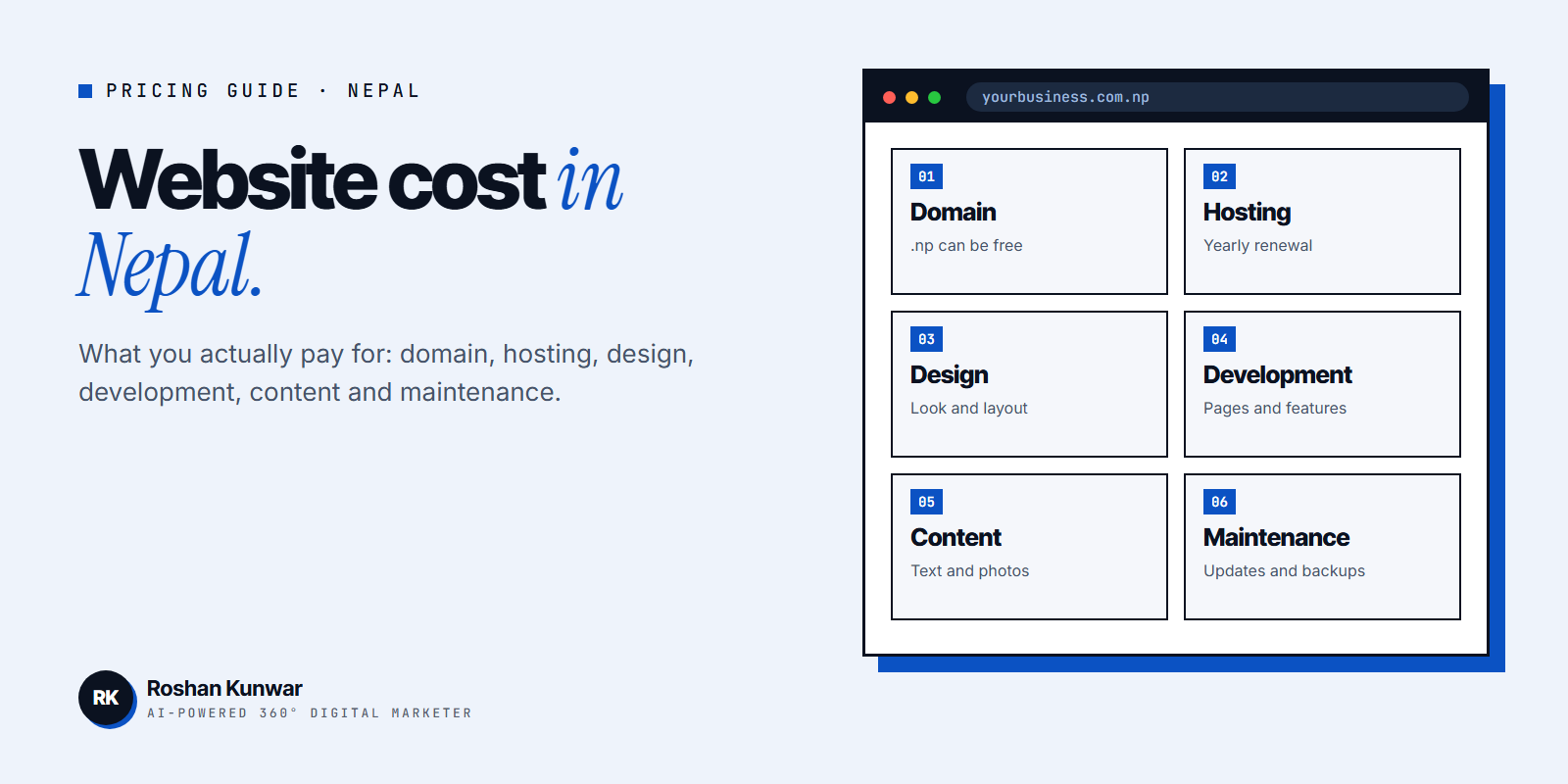
Every website, small or large, is made of the same building blocks:
| Cost item | One-time or yearly | What changes the price |
|---|---|---|
| Domain name | Yearly | .np is free; .com and others are paid every year |
| Hosting | Yearly | Shared vs VPS, storage, traffic, backups |
| Design | One-time | Template vs custom design, number of page layouts |
| Development | One-time | Number of pages, features, admin panel, payments |
| Content | One-time and ongoing | Who writes text, product photos, video |
| Maintenance | Monthly or yearly | Updates, security, backups, small changes |
When two quotes look very different, check which of these items each quote includes.
Is a .np domain really free?
Yes. The .np registry's registry policy states that domain registrations under the .NP ccTLD are free of cost. You apply through the registry with official documents that prove your local presence, and the registry checks them. Foreign companies need an official presence in Nepal to qualify.
A .com.np address also tells Google and customers that you are a Nepali business, which helps for local searches. The trade-off is that approval takes some time, so apply early. Many businesses register a .com as well and point it to the same site.
Keep your registry contact email up to date. The registry has been running a reverification process since December 2024 and sends renewal reminders to the registered admin email, so a wrong email can put your domain at risk.
Four common types of website
1. Landing page
One page with one goal, such as getting calls or WhatsApp messages for a single service or campaign. This is the cheapest and fastest type. It works well behind Facebook or Google ads.
2. Business website
Five to fifteen pages: home, about, services, projects or gallery, blog and contact. This is what most service businesses, schools, clinics and agencies need. Example: the PracharKhana agency website I built.
3. E-commerce website
Product listings, cart, checkout, order management and usually local payment options. The cost rises with the number of products, payment integrations and delivery logic. Example: the Gyane Store e-commerce landing page.
4. Custom web app
Software that runs in a browser, such as a booking system or hotel management system. This is priced by features and testing time, not by pages. Example: Stayflow hotel management system.
What makes a website cost more
- Custom design for every page instead of a template
- An admin panel so you can edit content yourself
- Online payments, user accounts or booking calendars
- Many languages, such as English and Nepali versions
- Content writing and photography done by the developer
- Tight deadlines that need extra hours
What makes it cost less, without hurting quality
- Start with the pages that bring customers, and add the rest later
- Prepare your own text, logo, photos and price list before the project starts
- Use a proven template or framework and customise colours and layout
- Agree on the number of revision rounds in writing
Hidden costs to ask about before you pay
Many website problems in Nepal start after launch, not before. Ask every developer these questions:
- Who owns the domain and hosting account? It should be in your name, with your email.
- What is the yearly renewal cost for hosting and any paid domain?
- Are backups included, and how often?
- Who fixes it if it breaks after launch, and is that free for a period?
- Can I edit text and images myself, or do I pay for every change?
- Is basic SEO included: page titles, meta descriptions, sitemap, mobile speed?
A cheaper quote that leaves out hosting, SSL or SEO basics can end up costing more.
How to get a fair quote
Send each developer the same short brief:
- What your business does and who your customers are
- The main action you want visitors to take (call, message, buy, book)
- The list of pages you need
- Any features: payments, booking, blog, admin panel, languages
- Two or three websites you like, with what you like about them
- Your deadline and budget range
With the same brief, quotes become easy to compare.
Do not forget SEO and speed
A website that nobody finds does not bring customers. At launch, make sure every page has a unique title and description, the site loads fast on mobile data, and it is connected to Google Search Console. For local businesses, link it to your Google Business Profile using my local SEO checklist.
FAQ
How long does it take to build a website in Nepal?
A landing page can take days, a business website a few weeks, and an online store or web app longer. The biggest delay is usually waiting for content, so prepare text and photos early.
Should I use WordPress or a custom-coded website?
WordPress is a good fit when you want many plugins and a familiar editor. A custom site can be faster and lighter when you need specific features. Choose based on who will maintain it.
Do I need a website if I already have a Facebook page?
A Facebook page is rented space; a website is yours. It shows up on Google, holds your full service details and works with ads tracking, so most growing businesses need both.
What yearly cost should I plan for after launch?
Plan for hosting renewal, any paid domain, backups and small updates. Ask your developer to list these in the quote so there are no surprises.