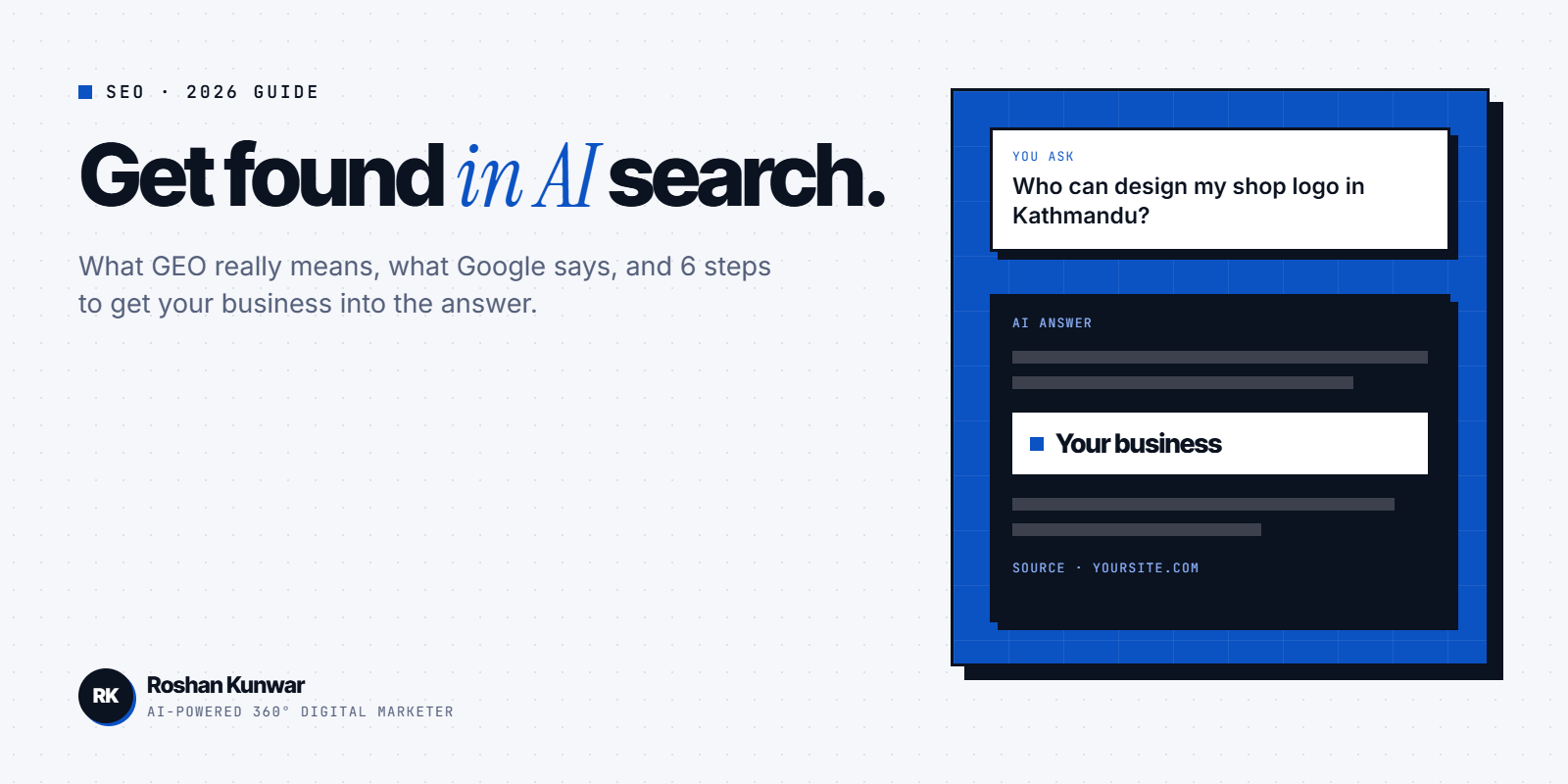
People no longer only type a few words into Google and open ten links. They ask a full question, read the AI answer and often stop there. If your business is not part of that answer, many of those customers never see you. That shift is why GEO, or generative engine optimization, is one of the most talked-about marketing topics of 2026.
There is also a lot of noise around it, including tools and "secret formulas" that promise AI rankings. This guide keeps to what the evidence supports and what a small business in Nepal can do this week.
What is GEO?
GEO is the work of making your content easy for AI answer engines to find, trust and cite. Those engines include Google AI Overviews, Google AI Mode, ChatGPT, Gemini and Perplexity. You may also see it called AEO (answer engine optimization) or AI SEO. The labels differ, but the goal is the same: when someone asks a question about your field, your business should be part of the answer.
The term comes from a research paper by a team of university and independent researchers, accepted to KDD 2024. In their tests, GEO methods raised visibility in AI answers by up to 40%. Treat that as a lab result rather than a promise, but it shows that how you write a page can change whether AI uses it.
Why it matters now
The clearest independent data comes from Pew Research Center, which tracked the real browsing of 900 US adults in March 2025.
| On a Google results page | Clicked a normal result | Clicked a link inside the AI summary |
|---|---|---|
| With an AI summary | 8% of visits | 1% of visits |
| Without an AI summary | 15% of visits | Not applicable |
Source: Pew Research Center, July 2025. This is US data and we do not have an equivalent study for Nepal, but the direction is worth planning for.
Two lessons follow. First, simple "what is X" pages will bring fewer visits than they used to. Second, a mention in the answer has value even without a click, because the customer may search for your name or message you directly afterwards.
GEO vs SEO: what actually changes
| SEO | GEO | |
|---|---|---|
| Main goal | Rank and earn the click | Get named or cited in the answer |
| Typical search | Short keywords | Full questions, often with follow-ups |
| Best content | A strong page for a topic | Clear answers, facts and proof |
| What to track | Rankings and clicks | Mentions, branded searches and enquiries |
Most of the foundation is shared. Google's own guidance says there are no additional requirements or special optimizations for AI Overviews or AI Mode, and that no special schema or new AI text file is needed. A page has to be indexed and eligible to show with a snippet. So be careful with anyone selling a magic "AI ranking file".
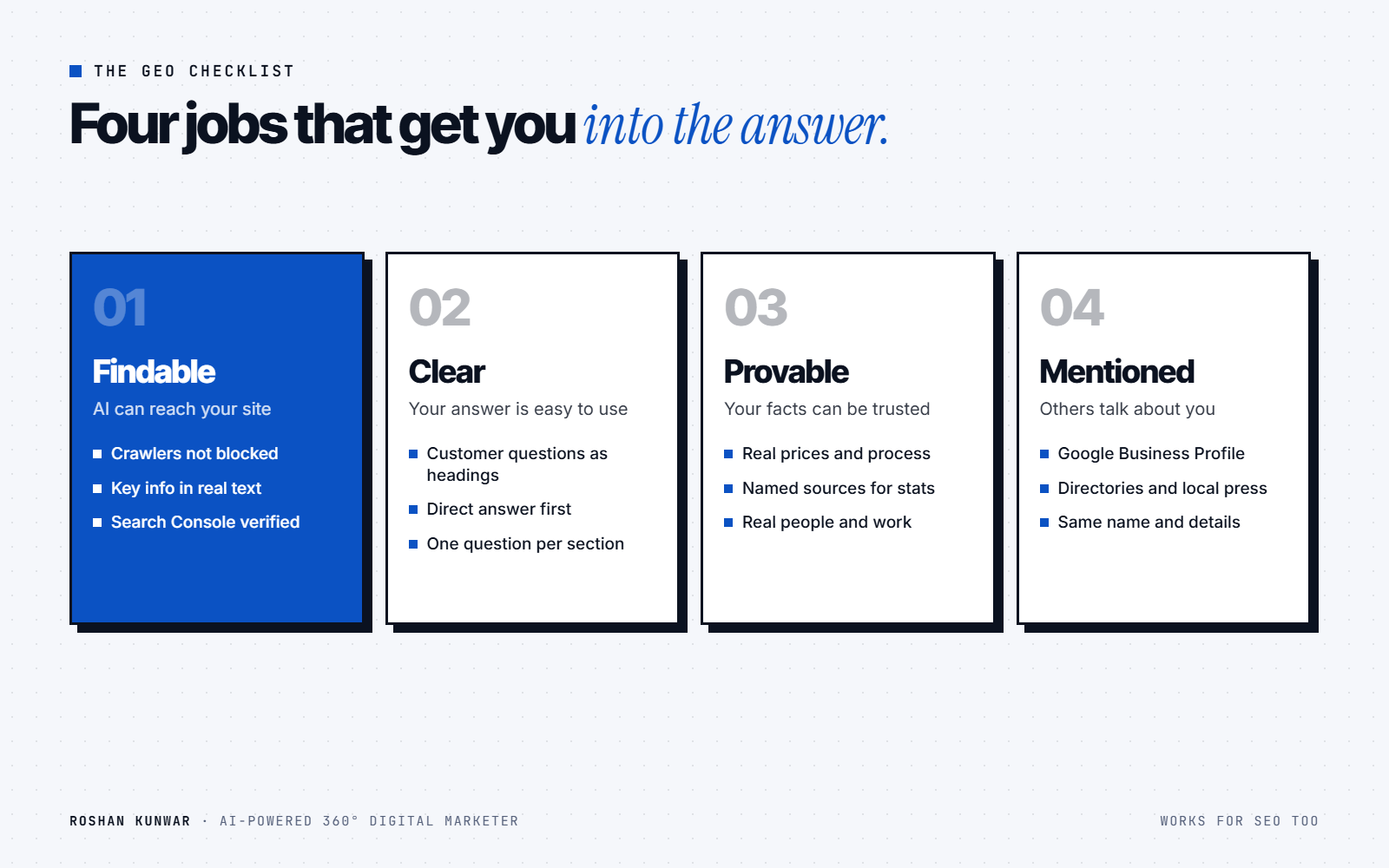
6 steps to show up in AI search
1. Make sure AI can read your site
Check that your robots.txt and hosting do not block crawlers, and keep important information in real text rather than only inside images. Many Nepali business sites put prices and services in a poster. People can read it, but plain text is far safer for search engines. Then verify your site in Google Search Console, which also includes AI feature traffic in its Performance report.
2. Answer one question per section
Use the real questions customers ask you on Messenger as your headings. Put a direct two-sentence answer right under each heading, then add the detail. "How much does a logo cost in Kathmandu?" followed by a real range is much easier to use than a paragraph about your passion for design.
3. Add facts only you can give
AI tools already have general advice. What they lack is your prices, delivery areas, timelines, process and results. Add specifics, and name the source for any statistic. Avoid keyword stuffing, since it adds nothing a reader or an AI tool can use.
4. Show who is behind the business
Add a real about page with names, experience, location and contact details. Show actual work and case studies. This helps customers trust you, and it gives AI tools something solid to describe.
5. Complete your Google Business Profile
Google lists keeping Business Profile information current in its guidance. For local searches, this is often your quickest win: correct category, hours, photos, services and honest reviews. My local SEO checklist covers it step by step.
6. Get mentioned on other websites
AI answers often draw on more than your own site. Directory listings, local news, partner pages, YouTube videos and genuine community discussions all help show that your business is real. Keep your business name, address and phone the same everywhere.
How to check if it is working
Reliable GEO tracking is still young, so use a simple monthly routine:
- Ask the tools: write 10 questions a customer would ask, try them in Google, ChatGPT, Gemini and Perplexity, and note who gets named.
- Watch branded searches: in Search Console, see whether more people search for your business name.
- Check your analytics: look for visits from chatgpt.com, perplexity.ai and gemini.google.com.
- Ask new customers: add "How did you find us?" to your enquiry form. It may be your best data.
AI answers change from person to person and day to day, so look for a trend over months rather than one result.
Mistakes to avoid
- Publishing hundreds of thin AI-written pages with nothing new in them.
- Buying a tool or "AI ranking file" that promises guaranteed citations.
- Blocking crawlers by accident through a hosting or firewall setting.
- Dropping normal SEO. AI search still depends on pages it can find and trust.
FAQ
Is SEO dead because of AI search?
No. Google's AI features use indexed pages, and its guidance says normal SEO practices still apply. What is changing is how much traffic some informational searches send, so strong SEO and clear answers now work together.
How long does GEO take?
There is no fixed timeline. Fixing your Business Profile and adding clear answers can be done in days. Earning mentions and trust usually takes months of steady work.
Do I need schema or an llms.txt file?
Google says no special schema or AI text file is needed for its AI features. Normal structured data is still useful when it matches what is visible on the page, but it will not make up for weak content.
Can a small business in Nepal really appear in AI answers?
It can, especially for local and specific questions where few businesses have published clear information. That gap is a real opening, though no one can guarantee a mention.