Every day, people in Nepal search questions like "website banauna kati lagchha?", "best gym in Lalitpur" or "how to apply for a visa". The businesses that answer those questions clearly are the ones people remember and call.
That is content marketing in simple words: you teach and help first, and sales follow. This guide explains what it is, why it works for Nepali businesses, and how to start with a small team and a small budget.
What content marketing is, and what it is not
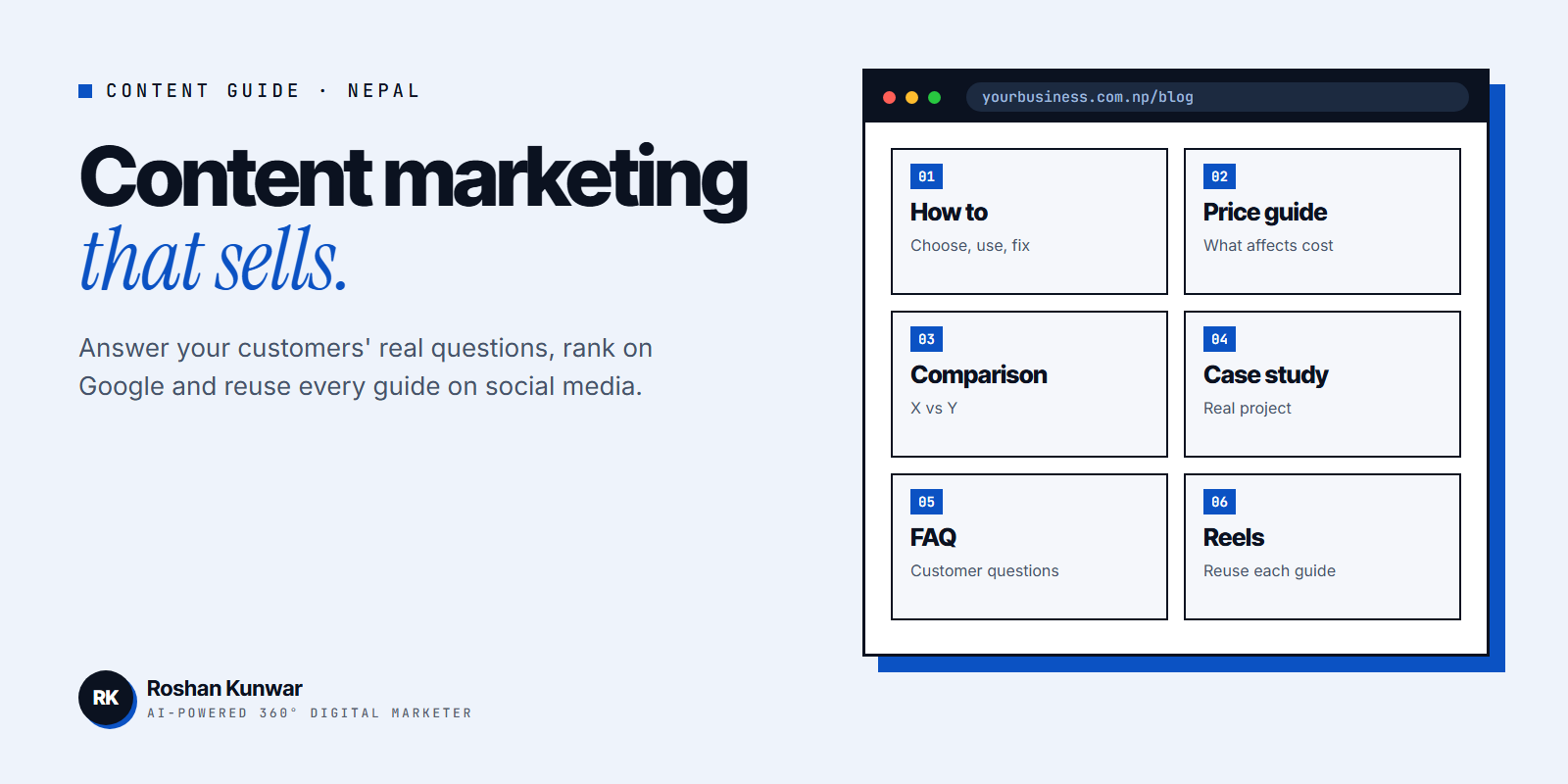
Content marketing is creating useful content for the people you want as customers. It can be a blog post, a short video, a carousel, a price guide, a FAQ page or a case study.
It is not posting "Happy Dashain" graphics and offer banners every day. Those posts have a place, but they do not answer questions or build trust on their own.
| Type of post | Example | Content marketing? |
|---|---|---|
| Festival greeting | "Happy Tihar from our team" | No, it is brand presence |
| Offer banner | "20% off this week" | No, it is a promotion |
| How-to guide | "How to choose the right school bag for kids" | Yes |
| Price explainer | "What affects the cost of interior design in Kathmandu" | Yes |
| Case study | "How we set up a hotel's booking system" | Yes |
| Comparison | "Gas geyser vs electric geyser for Nepali homes" | Yes |
A healthy mix uses all of these, but content marketing pieces are the ones that keep working for months.
Why it works for Nepali businesses
- People research before they buy, especially for higher-priced products and services such as courses, clinics, travel, real estate and software.
- Good answers build trust. A customer who learned something from you is more likely to message you than a competitor they have never heard of.
- Content can rank on Google and bring visits without paying for each click, which helps your SEO.
- One good guide feeds many social posts, so you are not starting from zero every day.
What Google looks for in helpful content
Google publishes guidance on creating helpful, reliable, people-first content. It includes questions you can use to check your own pages, such as:
- Does the content provide original information, research or analysis?
- Does it describe the topic in a substantial, complete way?
- Does the title give a helpful summary without exaggerating?
- Would someone want to bookmark it or share it with a friend?
- Does it have easily verified factual errors?
The guidance also suggests asking people you trust, who are not connected to your site, for an honest review. For a small business, that can be as simple as asking two customers if a guide answered their question.
How to start: a 6-step plan
1. Collect real customer questions
Look at your Messenger, WhatsApp and Instagram DMs. Write down every question customers ask before buying: price, delivery, sizes, process, timing, comparisons. Add questions your sales staff hear on calls. These are your first topics.
2. Pick 10 questions and turn them into topics
Choose the questions that come up most often and are closest to a purchase. Good topic types:
- Price and cost: "What affects the price of ...?"
- How to: "How to choose ...", "How to use ..."
- Comparison: "X vs Y: which is better for ...?"
- Problems: "Why does ... happen and how to fix it"
You can also type your main product or service into Google and look at the autocomplete suggestions. They show what people commonly search.
3. Write one strong answer per topic on your website
Each answer should be a page or blog post on your own website, not only a Facebook post. Your website is the place you control, and it is the place Google can rank. If you do not have a site yet, my website cost in Nepal guide explains what you need.
A good answer:
- Starts with the direct answer in the first few lines
- Uses clear headings, short paragraphs and a table where it helps
- Uses your own photos, examples and experience
- Ends with a clear next step, such as a WhatsApp link or contact form
4. Reuse each answer on social media
One guide can become:
- A carousel with the main points
- A 30–60 second reel where you explain the answer
- A Story with a poll or question sticker
- A short post with a link to the full guide
This is how a small team stays consistent. My social media marketing strategy guide explains how to plan these posts across the month.
5. Publish on a schedule you can keep
One good guide per week is better than five rushed posts and then silence for a month. Put the dates in a simple calendar and stick to it.
6. Measure what matters
| What to check | Where to find it | What it tells you |
|---|---|---|
| Search impressions and clicks | Google Search Console | Whether Google shows your pages |
| Top questions people searched | Search Console queries | New topic ideas |
| Messages after a post | Inbox and WhatsApp | Whether content leads to enquiries |
| Saves and shares | Instagram and Facebook insights | Whether people find it useful |
Review these once a month. Update the guides that get impressions but few clicks with a clearer title and a better first paragraph.
Content ideas by business type
| Business | Content ideas |
|---|---|
| Clothing store | Size guide, fabric care, what to wear for weddings in winter |
| Restaurant or cafe | Menu stories, how a dish is made, party booking guide |
| Education consultancy | Document checklist, timeline, common mistakes in applications |
| Clinic | What to expect in a first visit, preparation tips, FAQs |
| Tech or software | Setup tutorials, feature comparisons, case studies |
| Travel agency | Trek packing list, best season guides, permit process explainers |
Always check facts such as rules, fees and dates from the official source before publishing, and update them when they change.
Common mistakes
- Copying content from other websites. It does not help you rank and it damages trust.
- Writing for Google instead of people. Stuffing keywords makes posts hard to read.
- No call to action. Tell readers what to do next.
- Only posting promotions. People follow accounts that help them.
- Publishing and forgetting. Old posts with wrong prices or rules hurt your brand.
Using AI tools carefully
AI tools can help with outlines, first drafts, captions and turning a blog into a script. My guide to AI tools for business covers the main types. But always add your own experience, check every fact, and edit the result so it sounds like your brand. Content that only repeats what is already online is unlikely to stand out.
FAQ
Is content marketing free?
You do not pay per view or per click, but it costs time, and sometimes money for writing, design or video. Many businesses combine content with paid ads so new content reaches more people faster.
How long does content marketing take to work?
Social posts can bring messages quickly, but search traffic from blog content usually builds over months. Stay consistent and review results monthly.
Should I write in English or Nepali?
Write in the language your customers search and speak. Many Nepali businesses use English for website guides and mix Nepali in social captions and videos. Check Search Console queries to see what language people use to find you.
Do I need a blog on my website?
If you want to be found on Google for customers' questions, yes. A blog or guides section gives each answer its own page that can rank and be shared.