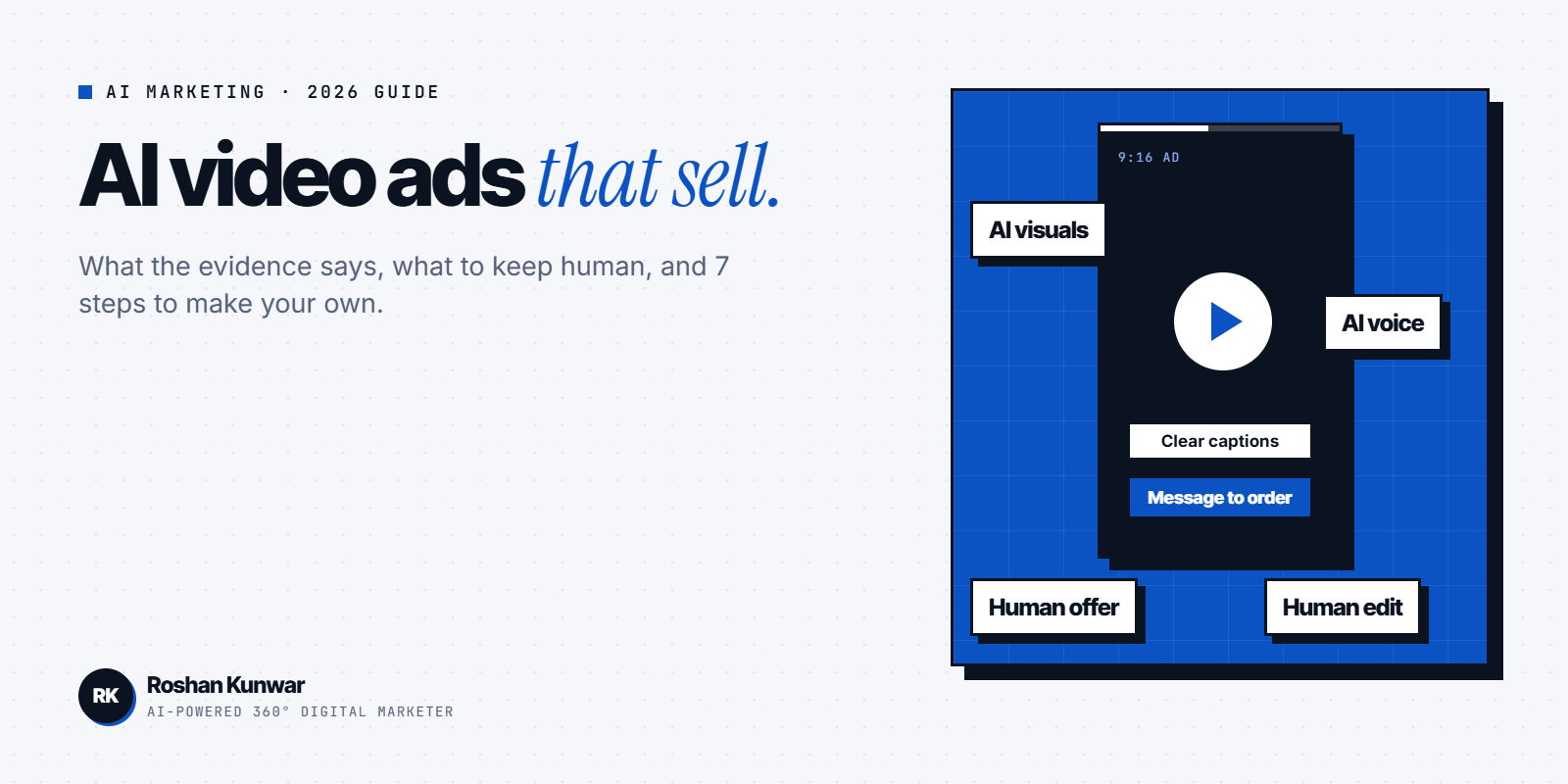
AI video has moved from a novelty to everyday marketing. Meta has reported that more than 8 million advertisers have used at least one of its generative AI ad tools. Scroll through Reels in Nepal and you will already see AI-made product ads in Nepali.
The question is no longer whether you can make one. It is whether yours will actually sell. I make these ads for clients, so this guide covers the evidence, the workflow I use and the mistakes that make an AI ad feel cheap.
Do AI video ads actually work?
Yes, sometimes, and the honest answer is more mixed than most tool websites suggest.
- In favour: some industry benchmarks report higher click-through rates for AI creative on Meta. One 2026 benchmark puts the lift at about 12%, though its method is not clearly explained, so treat the number with care.
- Against: research reported from Ipsos and Syracuse University found that fully AI-rebuilt 30-second ads scored about 14 to 17% weaker on average than the human originals. It was a small survey test of 10 brand ads.
- Trust is the open question: consumer scepticism remains a real concern, particularly for realistic AI people and avatars.
These studies measure different things in different markets, and none is specific to Nepal. Clicks are also not sales. The sensible approach is to test AI and real footage against each other using your own offer, then judge them by messages and orders.
Where AI helps and where it hurts
| Job | Use AI? | Why |
|---|---|---|
| Hook and script ideas | Yes, as a draft | Fast options, but you need to choose and rewrite them |
| Scenes and backgrounds | Yes | A festive or lifestyle setting without an expensive shoot |
| Voiceover | Yes, then check it | Quick and cheap, but Nepali pronunciation needs a careful listen |
| Variations for testing | Yes | Easy to try new hooks, formats and offers |
| Offer, price and promise | No | This is a business decision, and it must be true |
| Product details | Only with real references | AI can quietly change a logo, fabric or shape |
| Final edit | Human | Timing, clarity and taste decide whether it feels premium |
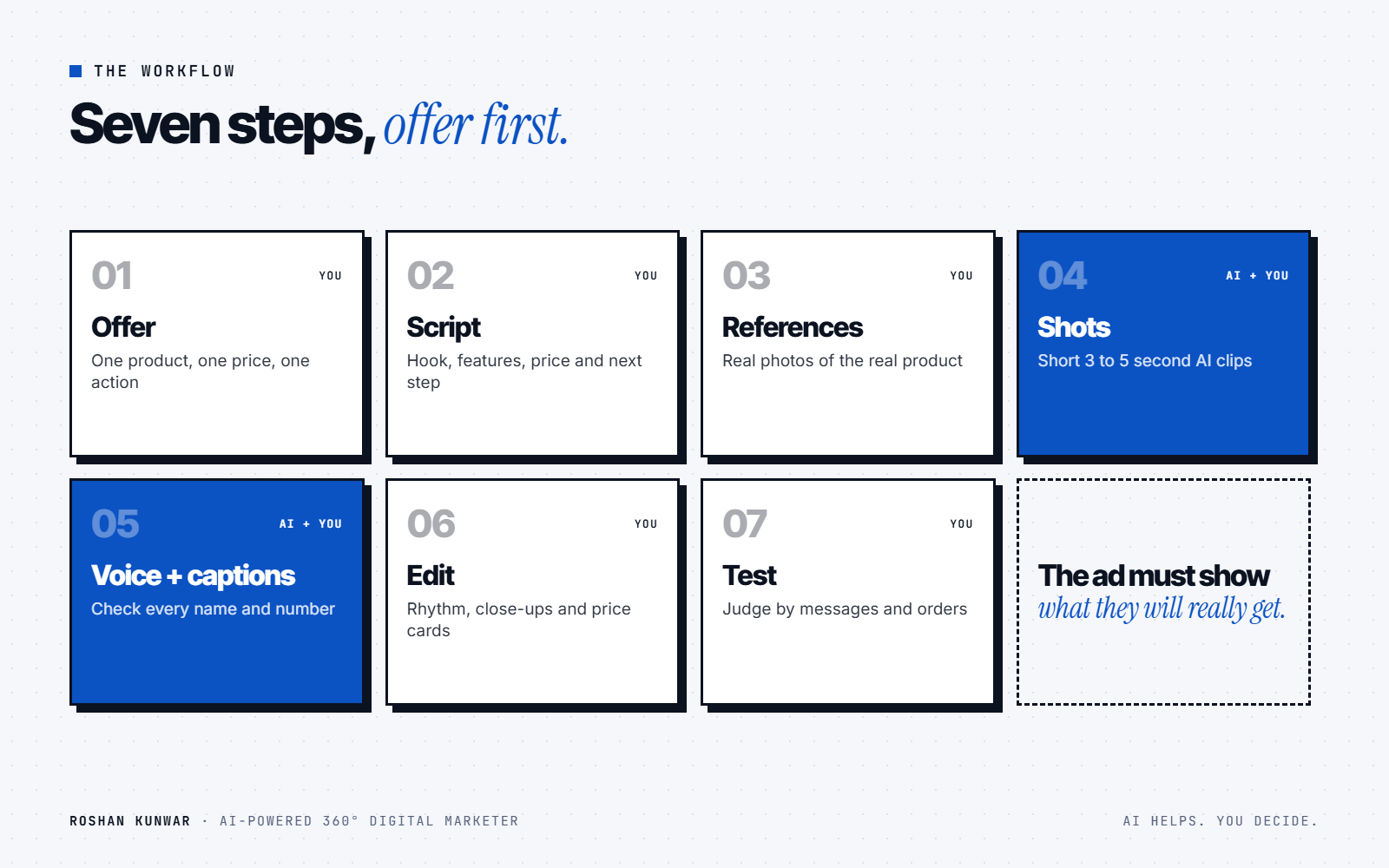
How to make an AI video ad in 7 steps
1. Start with one offer
Pick one product, one price and one action. "Rs. 2,199, message us to order" is much stronger than a video that tries to show your entire shop.
2. Write the script before opening a video tool
Plan the first three seconds, the features, the price and the call to action. Short Nepali lines usually work well, because captions have to be readable on a phone. Many people watch with the sound off, so the video should still make sense in silence.
3. Collect real product references
Take clear photos of the product from several angles, including the logo, texture and colours. These references help the AI stay close to what the customer will actually receive.
4. Generate short shots
Make 3 to 5 second clips rather than one long video. Short shots are easier to control, and a bad one can be replaced on its own. Generate several versions and keep only the best.
5. Add voice and captions
Listen to the full voiceover. Fix anything that sounds wrong, especially brand names, numbers and prices. Add captions in Nepali or Romanized Nepali, matched to your audience.
6. Edit like a real ad
Use cuts, close-ups, price cards and music timing to build rhythm. In my Sherpa jacket video ad, this stage did the most to turn separate clips into one clear message. Finish with one clear next step.
7. Test before you scale
Run two or three different hooks with a small budget, then keep the one that brings real conversations. My Meta Ads guide for Nepal explains how to set up that test.
AI labels and honesty
Meta applies an "AI info" label to ads made or significantly edited with its own generative tools, and it may also detect content from other tools through metadata. Rules change and published summaries disagree on the details, so read Meta's current ad policies before a big campaign, especially if your ad uses realistic AI people.
Whatever the platform asks, follow one simple rule: the ad must show what the customer will really get. If AI makes the fabric look thicker or the watch look more expensive than it is, you may get a click, but you will also get a return and a bad review. Do not use a real person's face or voice without their permission.
5 mistakes that make AI ads look cheap
- Changed product details: a warped logo or wrong colour damages trust at once.
- No real idea: beautiful shots without an offer give people no reason to act.
- Strange people: odd hands, faces and lip-sync draw attention away from the product, so show the product more.
- Flat voiceover: one unnatural Nepali word can make the entire ad sound fake.
- Copying a trend blindly: a style that suits a global brand may not suit your customer in Pokhara or Bhaktapur.
FAQ
How much does an AI video ad cost?
It varies with the tools, the length and how much editing it needs. Many tools have free or low-cost plans, but the real cost is the time spent on script, generation and editing. Ask for a quote based on your exact product and number of variations.
Is an AI video better than a real shoot?
Not always. Real footage is stronger when trust, people or testimonials matter most. AI helps most when you need several concepts quickly or a setting that would be expensive to shoot. Many of the best ads mix both.
Can AI make ads in Nepali?
Yes, including voiceovers and captions. Quality still varies, so always have a Nepali speaker check pronunciation, spelling and tone before you publish.
Will Facebook reject AI-made ads?
Meta allows AI-made ads as long as they follow its normal policies, and it labels some of them. Misleading claims or realistic content that deceives people can still cause problems, so keep it truthful.